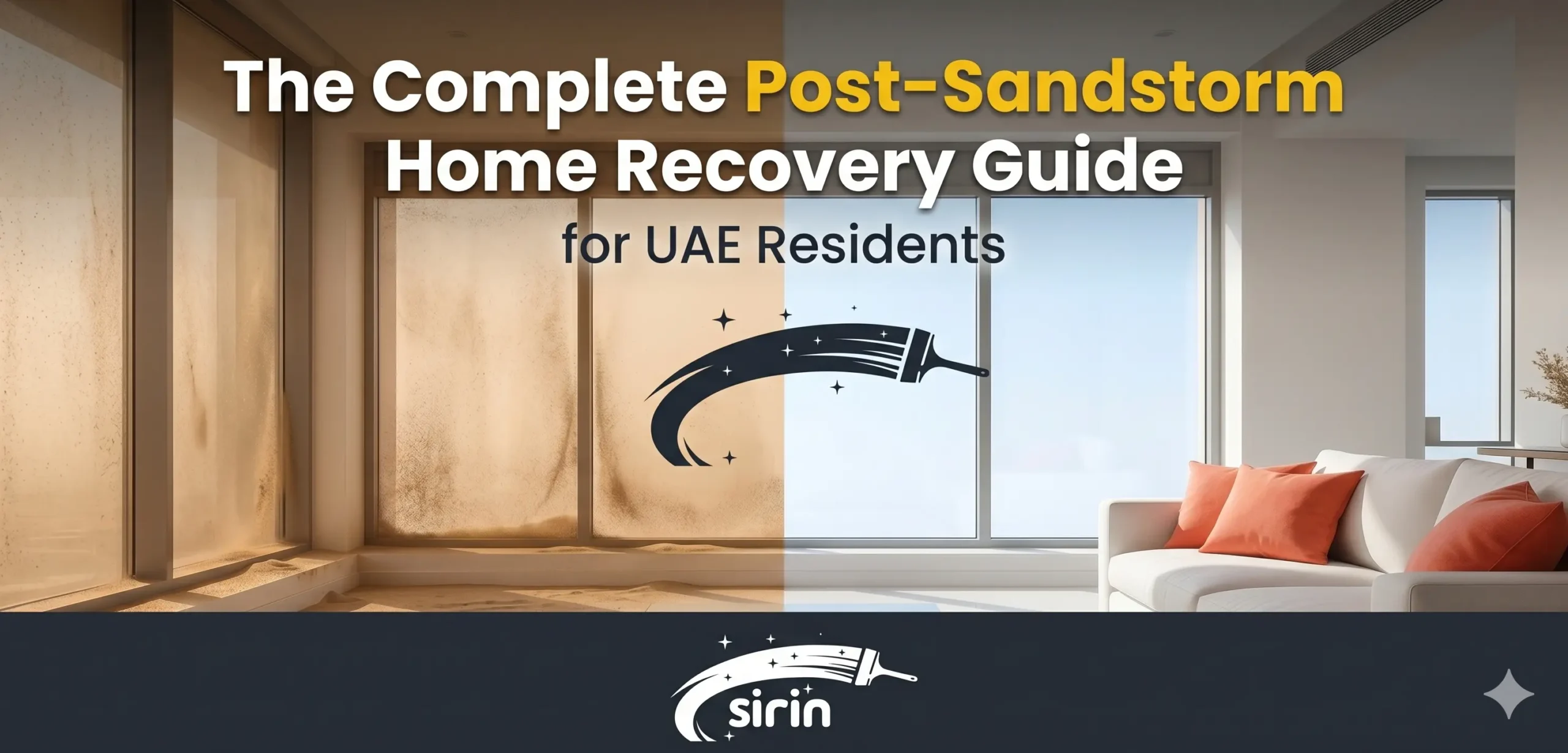
The sky turns orange. Visibility drops to a few hundred meters. And then, as quickly as it arrived, the sandstorm passes—leaving behind a layer of fine, powdery dust that seems to coat everything.
If you live in Sharjah, Ajman, or Umm Al Quwain, sandstorms are not a novelty. They are a seasonal reality. But what most homeowners do not realize is that the dust left behind after a storm is not ordinary household dust. It is silicate-rich desert dust—microscopic, abrasive, and capable of penetrating deep into your home’s surfaces, fabrics, and air circulation systems.
According to research published in the Pakistan Journal of Medical Sciences, exposure to sandstorm dust causes acute respiratory complaints in nearly half of all healthy individuals exposed, including persistent cough, runny nose, wheezing, and eye irritation. In one study of 517 healthy volunteers in Riyadh, 51% developed a runny nose and 48% suffered eye irritation after just a single 24-minute exposure to a sandstorm.
The danger does not end when the wind stops. That dust is now inside your home. And if you clean it the wrong way, you will make the problem worse.
Why Sandstorm Dust Is Different From Normal Dust
Standard household dust is mostly dead skin cells, textile fibers, and pollen. Sandstorm dust is fundamentally different. It contains:
- Crystalline silica particles from desert sand and crushed rock
- Airborne allergens including pollen and fungal spores
- Bacteria and virus-like particles that travel attached to dust grains
- Pollutants picked up during long-distance atmospheric transport
As noted by the American Thoracic Society, fine dust particles smaller than 2.5 microns can not only reach deep into your lungs—they may even enter your bloodstream. Coarse particles between 2.5 and 10 microns become trapped in the upper airway, causing irritation, coughing, and inflammation.
This is why simply opening your windows to “air out” the house after a storm is one of the worst things you can do. You are not ventilating; you are recirculating hazardous particulate matter.
The Health Impact: Why This Matters for Your Family
Medical practitioners across the UAE consistently report a spike in respiratory complaints following sandstorm events. According to Gulf News, doctors at Medeor Hospital Dubai warn that individuals with asthma, COPD, and chronic sinusitis are particularly vulnerable, as dust particles irritate airways and aggravate symptoms. Common post-storm health issues include:
- Coughing, wheezing, and shortness of breath
- Throat irritation and persistent sneezing
- Itchy or burning eyes and headaches
- Sleep disruption and, in some cases, psychological distress
Even if no one in your household has pre-existing respiratory conditions, the fine silicate dust that settles on your floors, sofas, and bedding becomes a chronic low-level exposure risk. Children and elderly family members are especially vulnerable.
Why Vacuuming and Wiping Is Not Enough
Here is the mistake nearly every homeowner makes after a sandstorm: they grab a standard vacuum cleaner and a damp cloth, and assume the job is done.
It is not.
Standard household vacuums—even those with basic filters—are not designed to capture microscopic silica particles. In many cases, they recirculate fine dust back into the air through their exhaust. Wet wiping can help on hard surfaces, but it does nothing for dust embedded in:
- Upholstery and fabric cushions
- Mattress layers and bedding
- Carpet fibers and rug backings
- AC duct interiors and vent slats
- Behind kitchen appliances and inside cabinetry
As cleaning experts note, silica dust does not settle like normal dust. It can stay hidden in the air or on surfaces, and simple sweeping or wiping cannot remove it effectively. Proper deep cleaning is the only way to make your home safe.
Room-by-Room Post-Sandstorm Recovery Checklist
1. Living Room & Majlis: Start With the Air
Your majlis sofas, fabric cushions, and curtains act like air filters during a storm—they trap fine particles deep within their fibers.
Wipe all hard surfaces (side tables, TV consoles, window sills) with damp microfiber cloths, rinsing frequently.
- Do not beat cushions outdoors; this re-releases dust.
- Use a vacuum with a true HEPA filter on all upholstered surfaces.
- Steam-clean luxury fabrics and Arabic majlis sets to extract embedded allergens.
- Wipe all hard surfaces (side tables, TV consoles, window sills) with damp microfiber cloths, rinsing frequently.
Sirin Tip: Our Upholstery Cleaning service uses steam and chemical-free care specifically designed for delicate fabrics and majlis sets common in UAE homes.
2. Bedrooms: Protect Your Sleep Environment
You spend eight hours a night breathing the air in your bedroom. If sandstorm dust has settled here, you are inhaling it unconsciously.
- Strip all bedding and wash at 60°C minimum.
- Vacuum mattresses on both sides using a HEPA vacuum.
- Dust and wipe ceiling fans, light fixtures, and closet tops.
- Check window tracks—fine dust accumulates heavily in sliding window rails.
3. Kitchen: The Hidden Grease-Dust Combination
Kitchens are especially problematic after a sandstorm because cooking grease on surfaces acts like an adhesive for dust particles.
- Degrease all countertops, backsplash tiles, and cabinet fronts.
- Clean inside and behind the refrigerator coils (dust accumulation here forces the appliance to work harder).
- Wash or replace range hood filters.
- Wipe down all food preparation surfaces with a sanitizing cleanser.
4. Bathrooms: Humidity + Dust = Mold Risk
When silicate dust mixes with bathroom humidity, it creates a gritty film on tiles and glass that standard cleaners struggle to break down.
- Scrub tile grout with an anti-microbial cleaner.
- Clean exhaust fans and vent covers (these trap enormous amounts of dust).
- Polish mirrors and glass surfaces to remove fine particulate film.
- Sanitize all fixtures and replace any damp towels that absorbed airborne dust.
5. Balconies, Windows & Outdoor Areas
- Wash balcony floors and railings before dust tracks back indoors on shoes.
- Clean window glass and frames—dust settles heavily on aluminum tracks and rubber seals.
- Check sliding door runners; vacuum out compacted dust to prevent mechanism damage.
The AC Trap: Why Your Air Quality Gets Worse Two Weeks After the Storm
This is the most overlooked post-sandstorm issue in UAE homes.
Your air conditioning system was running during the storm. It pulled in dusty air, and even with basic filters, fine silicate particles passed through and settled inside the ductwork, cooling coils, and vent interiors. Two weeks later, when you notice a stale smell or family members start coughing at night, the source is not a new virus—it is the storm dust being recirculated.
Basic AC vent cleaning (wiping the slats) does not reach the duct interior. Full AC Duct Sanitization requires high-grade antimicrobial treatment of all cooling ducts, extraction and washing of filters to standard, and equipment that homeowners simply do not have access to.
Starting from AED 250, our AC Duct Sanitization service removes 99% of allergens from your cooling system. Learn more →
When to Call Sirin Cleaning
At Sirin Cleaning, we built our Post-Sandstorm Recovery service specifically for the UAE climate challenge. This is not a standard deep clean with extra attention to windows. It is a clinical-grade extraction process designed to:
- Eliminate fine silicate particles from every surface and air duct
- Sanitize AC vents and cooling ducts to restore air quality
- Steam-clean upholstery and majlis fabrics without chemical damage
- Leave your home 99% allergen-free, guaranteed
We serve Sharjah (Al Rahmaniya, Muwaileh, Al Nahda, Al Taawun, Al Majaz, and more), Ajman (Al Nuaimiya, Al Hamidiyah, Al Rawda, Corniche, and more), and Umm Al Quwain (Al Salama, Al Raudah, Falaj Al Mualla, and more).
Same-day service is available. Get your instant quote in 60 seconds →
Final Thoughts: Treat the Storm, Not the Surface
A sandstorm is not a housekeeping inconvenience. It is an environmental event that introduces hazardous particulate matter into your living space. Wiping your countertops and running a standard vacuum might make the home look clean, but it does not make it safe.
For families across the Northern Emirates, the difference between surface cleaning and clinical-grade recovery is the difference between temporary relief and lasting air quality.
Your home should be your refuge from the desert climate—not a storage unit for it.
Ready to recover? Book your Post-Sandstorm Recovery clean today →